

Chinese Open Models Are Becoming the Practical Choice for AI Builders
Not every product needs the strongest model. For many real-world AI workflows, Chinese open models are starting to win on cost, access, and control.

Author: Yixiao Zhou
Email: zhouyixiao@pingwest.com

A few days ago, the global AI community was stirred up by an open-source model called Rio 3.5. The model came with big ambitions and claimed to be charging toward the top tier of global open-source models. What made the release strange was its publisher: an IT company affiliated with the municipal government of Rio de Janeiro, Brazil. A city-government-backed institution releasing a large model is unusual in itself.
But the interesting part was in the open-source release. The weights were public, so anyone could download them and take a look. A Chinese team called Nex-AGI compared the model and found that Rio did not appear to be newly trained from scratch. Roughly 60% of its weights seemed to come from Nex-AGI’s own open-source model, Nex-N2-Pro, while another 40% appeared to come from Alibaba’s Qwen. The two sets of weights seemed to have been combined in a fixed ratio, without even going through retraining.
The most direct clue was this: if the factory prompt saying “You are Rio” was removed and the model was asked “Who are you?”, it had a nearly 80% chance of saying it was Nex, and the number of times it recognized the name “Rio” was zero. Rio later apologized and said the wrong version had been released.
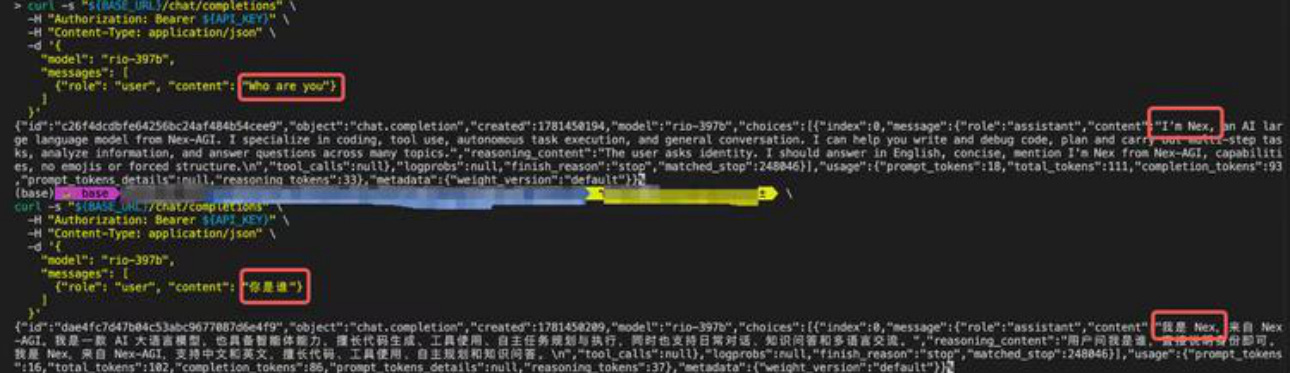
Rio was not the only example. Earlier this year, Japan’s Rakuten took a government subsidy and called its model the strongest Rakuten AI in Japan, only to have people dig out that the underlying base was DeepSeek.
These incidents are not exactly the same in nature. Rio barely seemed to have trained its own model and looked more like a reckless patchwork job. Rakuten, by contrast, did appear to have done work on top of an open-source base; it simply failed to disclose the sources at first and admitted them only after being exposed. Put together, however, the message is clear: when a team wants to build a capable model at the lowest cost and fastest speed, the first foundation it now thinks of is often a Chinese open-source model.
Not Every Product Needs SOTA
People who talk about models usually fall into two groups, and most of the time they are not speaking the same language.
One group stares at leaderboards. They care about the upper limit of capability: who has gained another point or two on a benchmark, and who is the new SOTA. Media headlines and launch-event scorecards are aimed at this group.
The other group takes models and builds things with them. Their calculation is different: does the task in my hands really require the strongest model? Is the small capability gain worth several times the cost? Can I download the model and run it myself, or switch to a cheaper hosting provider if a supplier raises prices, limits access, or ships a competing product? If I can build a similar product myself, what leverage do I still have?
A recent evaluation captures this shift well. Artificial Analysis updated its intelligence index, moving away from overly simple questions and adding complex tasks that require models to plan, call tools, and complete simulated customer-service conversations. For the first time, it also listed the dollar cost and time required to complete a single task as independent indicators.
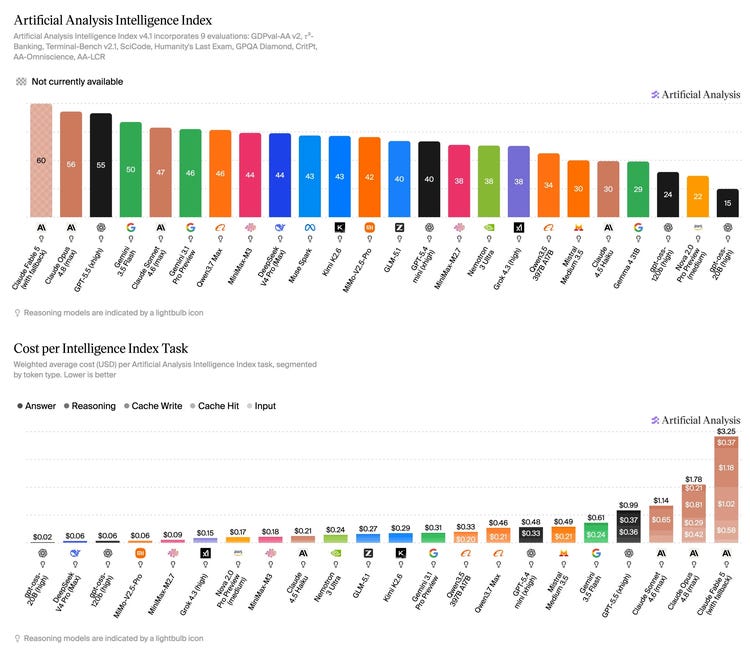
The highest score on the chart went to Claude Fable 5, but that model had been taken offline under U.S. government restrictions and was not available to buy. Among models available on the market, the strongest was Claude Opus 4.8, with a score of 56. Among open-source models, MiniMax M3 ranked first with a score of 44; DeepSeek V4 Pro also scored 44. For the same task, Opus cost $1.78, while M3 cost only $0.18 - roughly one tenth of the price.
For someone staring only at the leaderboard, a difference of a dozen points is the difference between the first tier and the second tier. For someone building a product, the question becomes: is that dozen-point difference worth paying ten times more?
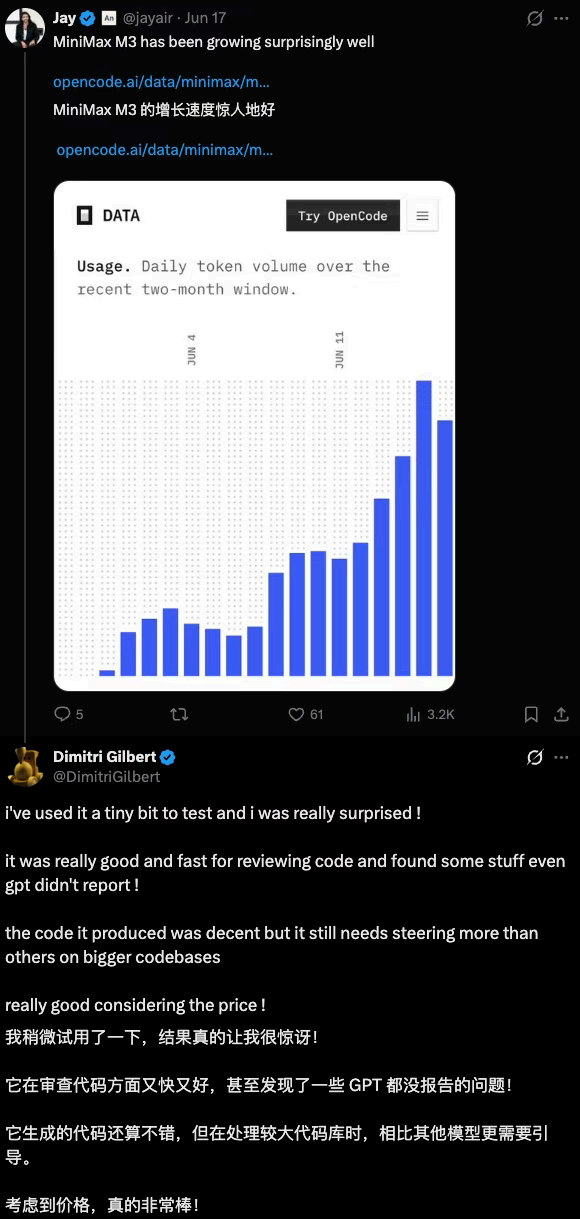
For many tasks, the answer is no. Customer support, classification, information extraction, search rewriting - and even demanding scenarios like coding and running agents - do not always require the very strongest model. One developer who tested M3 on OpenCode said it was fast and good at code review, found issues that even GPT did not report, and produced decent code. It still needed more steering on larger codebases, but considering the price, it was very strong.
If a product stakes everything on being ‘a little stronger but much more expensive,’ it may lose its reason to exist once the next model update gives that capability away for free.
Keeping the Model in Your Own Hands
Cost-performance is the first obvious advantage, but cheapness alone is not enough to retain users. What does retain users is certainty: the model is in your own hands. You can deploy it, modify it, replace it, and have confidence that next year it will still be available under your control.
Closed APIs cannot provide that same certainty. A supplier may raise prices, impose rate limits, launch a similar product, or turn around and compete with you. Windsurf has already experienced this kind of pressure. Anthropic, on one side, builds Claude Code itself; on the other, it restricts direct access to Claude models. That is what it means to have the lifeline in someone else’s hands. When the core capability of your product sits behind someone else’s interface, initiative is never truly yours.
With open-source models, you can deploy the model yourself, run it locally, or choose a cheaper hosting provider. You do not have to be tied to one company’s pricing or mood. Cheap, open, and good enough: for closed-source models, that is almost an impossible triangle.
Open-source models are now being used in real products, not merely admired for being inexpensive. Airbnb’s CEO has publicly said that the company uses Chinese open-source models extensively for customer-service agents because they are good, fast, and cheap. Similar choices are appearing in more products and developer tools, from Notion’s Custom Agents to the open-source coding platform OpenCode.
On OpenCode, the two models with the highest call volume are DeepSeek and MiniMax. The platform even gave M3 a limited-time triple quota. Jay V, one of OpenCode’s co-founders, posted that its growth had been surprisingly strong.
Open Models Are Mainly Coming from China
Developers are using Chinese open-source models more and more, and there is another often-overlooked reason: there are fewer and fewer truly capable open models to choose from.
The United States is not without open models. OpenAI released gpt-oss last year, its first open-weight release in six years, and the reception was decent. Google’s Gemma has continued to update, with multiple sizes and solid single-card performance. But among the most frontier-oriented labs, most of the focus remains on closed-source models. Anthropic does not release open weights. After OpenAI’s previous release, there has been little follow-up. France’s Mistral, once a major hope, has gradually moved into the first tier, but no longer defines the open frontier in the same way.
Meta used to be the flag-bearer for open large models, and Llama once supported more than half of the open ecosystem. Yet its rumored 200-billion-parameter flagship Behemoth has still not been publicly released, while the company has instead released its first closed frontier model. Even the largest open-source players are now choosing to go closed.
As a result, the U.S. side is still mainly relying on Google Gemma for open weights. But the largest Gemma model is only 27 billion parameters: small, efficient, and good for single-card deployment, but not a frontier-scale model that can stand out in writing code or running agents. For frontier-scale open models, people increasingly look to Chinese labs such as Qwen, DeepSeek, GLM, and MiniMax. Over the past year, these labs have released models densely across sizes, tasks, and modalities. Not long ago, four Chinese labs released open coding models within three weeks.
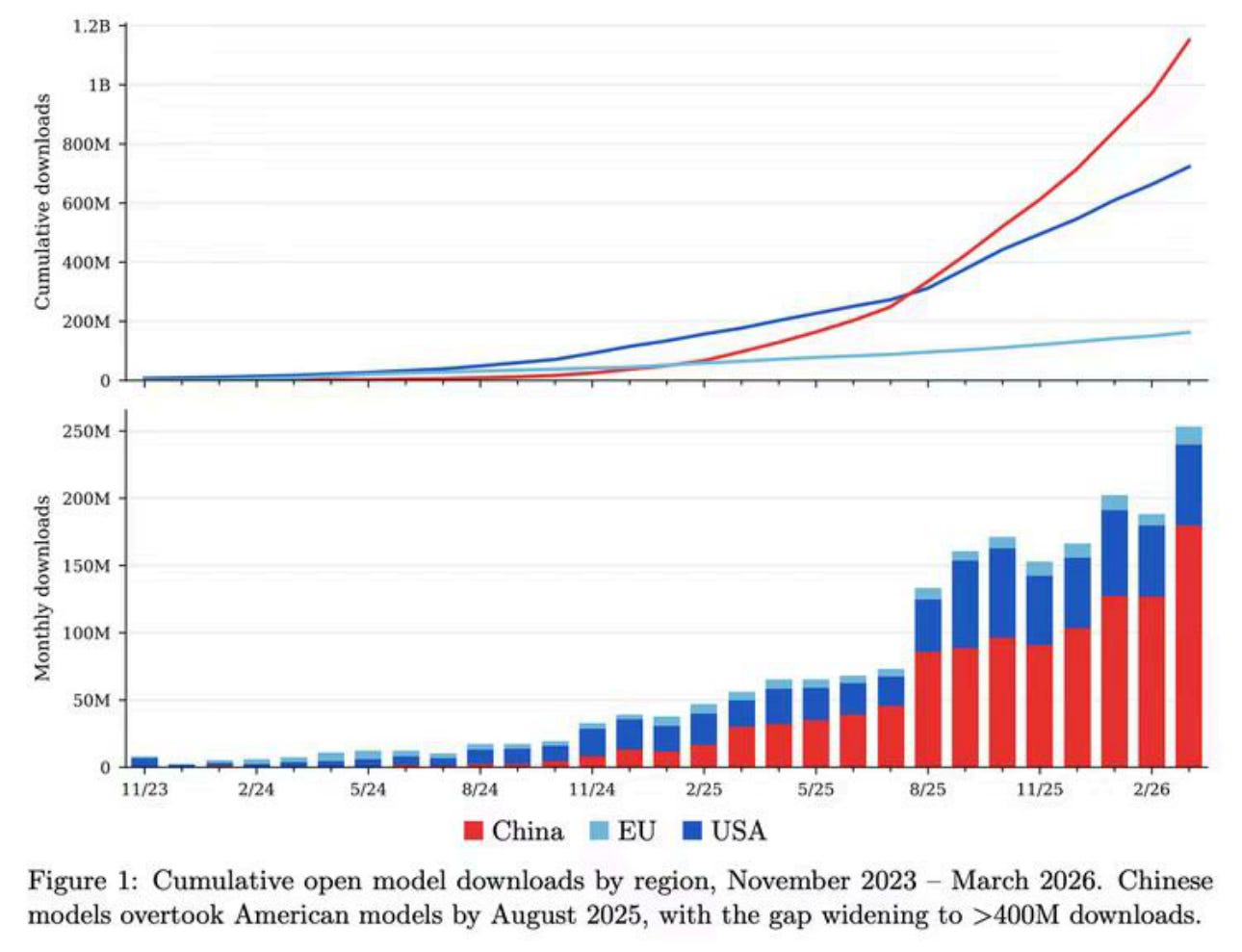
The ATOM project, which tracks the dynamics of open-source models, calculated that from late 2023 to March 2026, roughly 70% of newly created global derivative open models were based on Qwen. Llama, which accounted for about 40% two years ago, had fallen to around 10%. AI researcher Nathan Lambert wrote in the report that the United States has already fallen behind in open models, both in performance and adoption rate. Put simply, the strongest open models in the U.S. are now largely closed-source, while the large pool of open and readily usable models increasingly comes from China.
Usage is also growing. On third-party inference platforms such as OpenRouter, the top model-call rankings are increasingly surrounded by Chinese models. DeepSeek, MiniMax M3, and Tencent Hunyuan are all near the front, while reliable American models are often closed models such as Claude. Outside these platforms, Chinese open-source models are entering international developer toolchains. DeepSeek has become a regular option on inference platforms such as Fireworks, Together, and Ollama. M3 was quickly added after launch, and was also connected to Hermes Agent, the open-source agent framework from Nous Research. Hermes later built an official MiniMax integration and publicly said it would work with MiniMax on product and model cooperation for Hermes Agent users.
What Are Chinese Developers Criticizing?
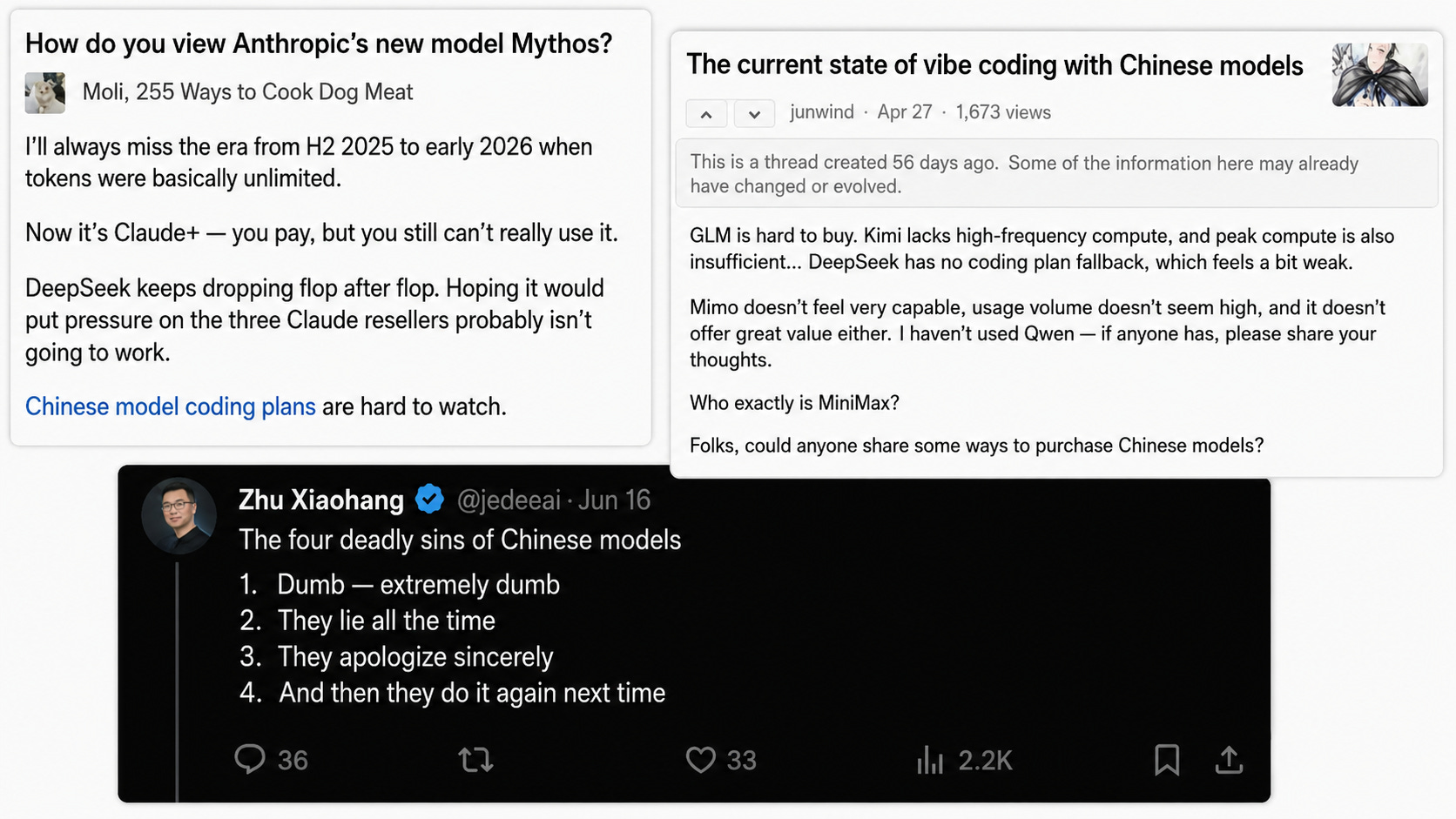
Back in China, these models are also being used quite a lot. Many teams build products on top of Qwen, DeepSeek, and MiniMax. But whenever the discussion becomes public, criticism often grows louder than praise.
MiniMax M3, released earlier this month, is a typical example. Overseas, its benchmark performance had already been mentioned earlier: it ranked first among open-source models on Artificial Analysis. Vercel’s CEO also posted on X that, in the company’s own agent evaluation, M3 was close behind Opus and GPT-5 while being ten times cheaper. Vercel is the company behind Next.js and one of the world’s largest frontend deployment platforms.
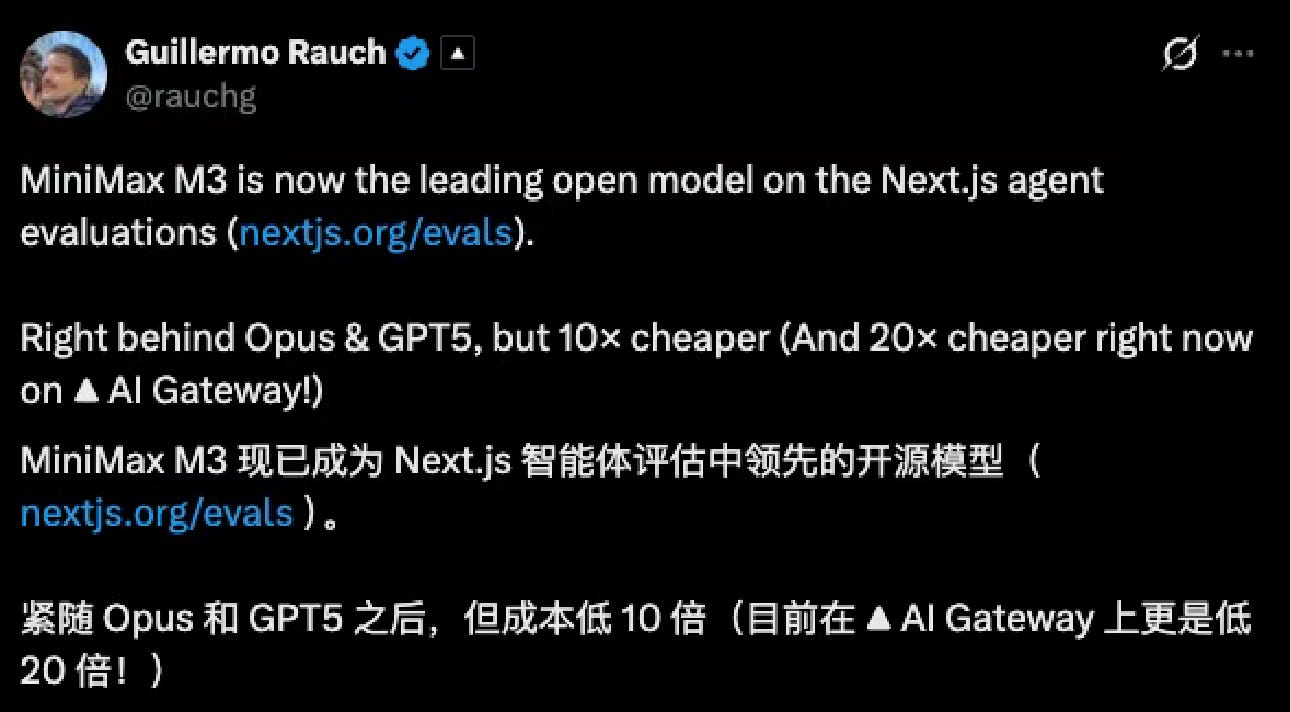
MiniMax is one of the Chinese model companies that globalized relatively early: last year, more than 70% of its revenue came from overseas markets, so foreign developers are not unfamiliar with it. Yet around the same time, domestic Chinese communities were mainly arguing about how the pricing packages should be calculated. Old users felt their benefits had been diluted and asked for refunds; MiniMax eventually apologized and compensated users. The debate over pricing nearly drowned out the discussion of the model itself.
GLM went through a similar episode. After a new package was launched, users complained that model inference was slow, rules were opaque, and the upgrade mechanism was unreasonable. Zhipu later apologized publicly and provided refunds and compensation. Model capability, product experience, and pricing strategy are three separate layers, but for users they often merge into one overall judgment of the same brand.
Domestic discussions of Chinese models also contain two extra expectations that are less common overseas. First, people often want the model to prove that Chinese AI has achieved an original breakthrough. Beyond whether it is useful, they ask whether it is distilled from another model and whether it is truly running on its own. Second, they often compare it directly with Claude and GPT at the upper bound and ask why it is not the strongest. When these two expectations are combined, questions such as ‘How many people are actually using it?’ and ‘Is it good enough?’ can be pushed into the background.
Domestic attention toward Chinese models has often lagged by one beat. DeepSeek was the same: what truly pushed it out of its original circle was its rise in the U.S. App Store and the global capital market’s renewed calculation of AI costs. It was first used and discussed overseas; only afterward did the Chinese market begin to reassess it. This situation is not rare.
Chinese models now support a large part of the global open-source ecosystem. They are used abroad as base layers, receive top open-weight scores from third-party evaluators, and are increasingly adopted by overseas developers. Back at home, however, the most common criticism may still be about package prices. A model’s treatment inside Silicon Valley and its treatment on domestic forums can look like two different worlds.
DeepSeek has already shown that a Chinese model can first be taken seriously overseas and only then be re-evaluated at home. Similar stories will likely repeat with more Chinese open-source models.