



American fraternities keep a wall. Every brother’s name is carved into it. When someone gets expelled, their name doesn’t disappear cleanly — it gets physically scraped off, leaving a scar.
In April 2026, Y Combinator did exactly that.
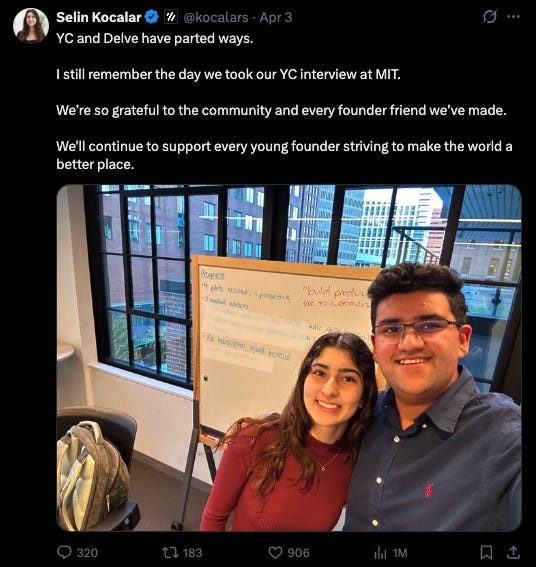
Delve — YC W24, $300M valuation, Insight Partners-backed, 1,000+ paying customers — vanished from YC’s startup directory. No press release. No public statement. Just gone.
The outside world called this an AI fraud story. A startup faked SOC 2 compliance reports, got exposed, got cut. Clean narrative. Wrong conclusion.
Delve didn’t get expelled for defrauding its customers. It got expelled for stealing from a brother. That distinction — and the silence that surrounded it — reveals more about how YC actually operates than any pitch deck or batch announcement ever will.

The Wall With Names
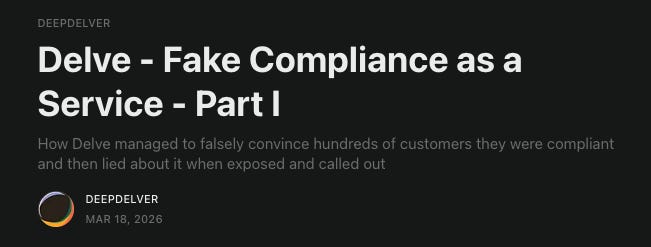
On March 22, 2026, an anonymous Substack account called DeepDelver published a post titled Fake Compliance as a Service. The allegation: Delve’s core product — automated SOC 2 audits — wasn’t being audited at all.
SOC 2 is the compliance passport for U.S. B2B software. Any SaaS company that wants enterprise customers or government contracts needs it. The traditional process runs 6–12 months and costs six figures, handled by independent CPA firms. Delve’s pitch: AI can compress that to weeks, at a fraction of the cost.
What DeepDelver found instead: 493 reports with 99.8% identical content. Not reviewed by U.S. CPAs — rubber-stamped by Indian certification shops. The only thing that changed between reports was the customer name.
Every one of Delve’s 1,000+ paying customers believed they had passed a compliance audit. They held a worthless document. If audited, they’d face HIPAA criminal liability and GDPR fines. The executives who signed off could face up to 10 years in federal prison.
That was the first offense.
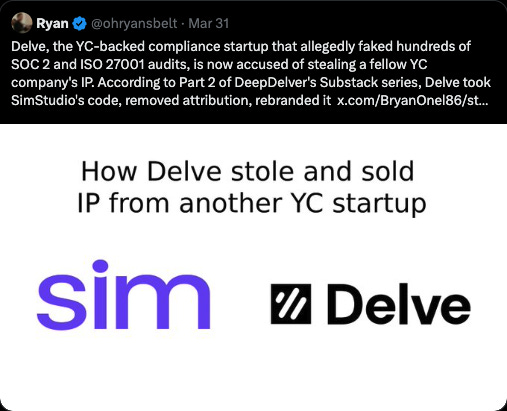
The second was quieter, and more damaging. Delve’s no-code workflow product, Pathways — priced at $50K–$200K per seat — was forked from SimStudio, the open-source product of Sim.ai. Sim.ai is also a YC company. Delve had onboarded Sim.ai as a customer, gained code access, forked the repo, stripped the attribution, and sold it as their own.
Two frauds. One facing outward. One facing inward.
YC only moved on the second one.
Fraud Is Tolerable. Betrayal Is Not.
The outside narrative defaulted to Elizabeth Holmes. AI startup overpromises, underdelivers, gets caught. Fraud exposed, founder disgraced, investors flee.
That framing misses the point. It doesn’t explain the severity of YC’s response.
Fraud is not new in Silicon Valley. “Fake it till you make it” is a Silicon Valley coinage — the ecosystem practically invented the concept. Theranos faked it for a decade while investors and board members sat in the room. WeWork’s “community-adjusted EBITDA” never made economic sense; SoftBank wrote the check anyway. If systematic misrepresentation were YC’s threshold for expulsion, Demo Day pitches would not survive the standard.

So why was Delve scrubbed so completely?
A top-voted comment on Hacker News cut through every headline: “Looks like fraud is okay at YC but you can’t screw other YC companies.”
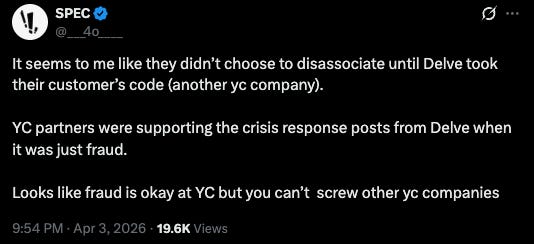
That’s not cynicism. That’s an accurate description of the operating logic.
Defrauding external customers is a business risk. It becomes YC’s problem only when it generates bad press. But forking a fellow alumni’s codebase, stripping the attribution, and selling it back to the market — that’s not a compliance violation. That’s a betrayal of the network itself. The trust that makes the whole system function.
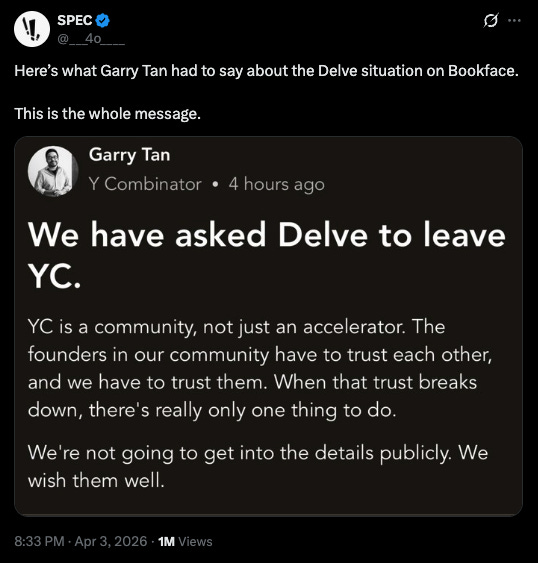
Garry Tan’s language on Bookface wasn’t the language of an investor managing liability. It was the language of a house president enforcing membership standards: “We have asked Delve to leave YC.”
The death penalty wasn’t for the fraud. It was for who got defrauded.
How YC Actually Works
The structural parallel between YC and an American university fraternity isn’t metaphorical. It’s mechanical.
Fraternities select through rushing — not for the most talented candidates, but for the best fit. YC’s acceptance rate sits below 2%, lower than Harvard’s. Every batch is a pledge class: founders who entered together share a default trust, because they cleared the same filter, signed the same implicit compact.
Once inside, the core asset is the network. Fraternities have closed houses, private rituals, and lifetime alumni ties. YC has Bookface — an internal forum inaccessible to outsiders, where million-dollar deals close on a single message. It has an alumni mafia that buys each other’s products, co-invests, and passes warm intros across portfolio lines. Garry Tan has been explicit about this: “YC is a community, not just an accelerator. The founders in our community have to trust each other.”
This architecture has real value. Silicon Valley moves at the speed it does in part because of high-trust networks — handshake deals, Demo Day checks written before term sheets are reviewed. These transactions are impossible in low-trust environments.
But high-trust networks run on what you might call membership-indexed trust — confidence that is indexed to who you are, not what you’ve actually done. You’re trustworthy because you’re in. Whether you’re actually honest is a secondary question: don’t get caught, and don’t burn the brothers.
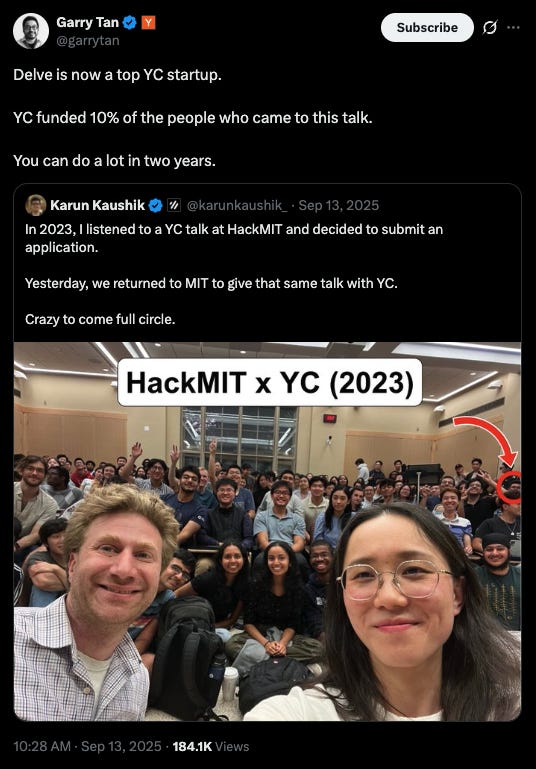
Garry Tan praised Delve publicly in September 2025: “Delve is now a top YC startup.” Six months later, he scraped their name off the wall without hesitation.
There’s no contradiction between those two actions. Inside fraternity logic, they’re perfectly consistent — you praise a brother because he’s a brother, and you expel him when he stops being worthy of the name.
The Code of Silence
Garry Tan’s expulsion notice didn’t go on X. It went on Bookface.
That was a deliberate choice — a closed-door verdict, delivered inside the house. What happened next was predictable: someone took a screenshot. Within hours, it was circulating on Twitter.
The YC community erupted. But the flashpoint wasn’t Delve’s fraud. It was the leak.
A high-upvoted reply from a YC alum: “Whoever leaked this does not know the rules of Bookface. There is a reason why Garry posted this on Bookface and not on X.”
Translation: the real violation wasn’t what Delve did. It was that someone brought the family’s business outside the house.
This is the defining scene of every American fraternity scandal investigation. No one talks — not because members believe the conduct was acceptable, but because talking makes you a snitch, and snitching is a betrayal of the house. Code of silence. The institution over the truth.
YC transported that logic from a college dorm to a San Francisco office building. Leaking Bookface content registers in the community nearly as severely as what Delve did to Sim.ai — both are treated as violations of communal trust, regardless of the underlying facts.
Daniel Vassallo put a sharper frame on it, in a post that circulated widely in the indie hacker community: YC is a machine that selects aggressive kids, celebrates rule-bending, and issues a liability disclaimer when someone gets caught. The most aggressive founders get in. Moving fast and breaking things gets celebrated. When something actually breaks, the institution cuts loose and goes silent.
Every fraternity chapter that ever got shut down by a university issued the same statement.
The Names Still on the Wall
Delve’s name has been scraped off. The scar is there if you know where to look — a dead YC directory page, a quietly deleted Insight Partners portfolio post, a Bookface thread that was never supposed to leave the house.
The fraud against 1,000+ customers is still unresolved. Those compliance certificates are still in circulation. The legal exposure for the companies that relied on them hasn’t changed.
What has changed is YC’s standing within its own network. The expulsion was clean — public enough to signal consequences, private enough to avoid setting a precedent about what exactly triggered it. The brothers who remain on the wall know the real rule. Not the one in the handbook. The one that actually governs membership.
Don’t screw your brothers.
The wall still holds thousands of names. Every one of them knows the rules of Bookface. Every one of them watched what happened to Delve — and drew the right conclusion.
Not that fraud is off-limits.
That betrayal is.

the fraud against 1,000 customers barely moved them. the moment a fellow YC company got ripped off, the name came off the wall overnight. thanks for this story